Epic Aerial Photography: How to Make Great Pics from a Plane
Aerial photography view of ice and water on the Greenland Ice Sheet.
The aerial photography adventure I undertook, while flying over Greenland, was an absolutely amazing experience. Let’s explore the range of simple and highly actionable tips and techniques I used to make great pics during that incredible flight.
Aerial photography provides a unique and, often, abstract viewpoint on our world. Scale is lost, particularly when the horizon is excluded from the composition. Roads become lines, lakes resemble circles, and our sense of perspective is challenged, changing the way we perceive the world below.
As a case in point, the above photo showcases an immense landscape yet, seen from above, the image is less about space and more about shape, color and texture.
It’s a massive landscape, but it looks almost like a miniature in this picture. With a loss of scale, there’s little indication of the distances or difficulties involved in traversing this landscape.
And that’s okay, because it makes the viewer stop, look a little longer and a little harder, to better make sense of what’s actually being depicted in the photo.
In fact, this example of aerial photography showcases but a tiny portion of the massive Greenland Ice Sheet.
At 1.7 million square km, and covering 80% of Greenland, it’s the second largest ice mass on our planet.
It’s worth noting that, if melting continues to accelerate at such a significant rate, we could be in serious trouble.
White Balance for Aerial Photography
And what about the cool, cyan/blue colors that dominate this image?
Snow is highly reflective subject matter and, on this glorious summer’s day flying over Greenland, blue skies dominated the trip.
In the case of the above aerial photograph, the color of the sky is being reflected off the ice.
That cold, bluish color is a powerful visual and emotive element in the picture, making us even more conscious of the coldness of the environment depicted.
The landscape looks wild and beautiful, but also harsh and forbidding. You might even think of it as alien.
By switching my camera off Auto White Balance, and selecting the Sunny/Daylight/Direct Daylight white balance setting, I was able to record the actual color of the light and its effect on the landscape.
Would you’d like to know more about using white balance to correct or alter the color in your own photos?
I’ve created a detailed and highly accessible guide on white balance, which I’d urge you to read. It’s titled Best White Balance Settings: How to Improve Your Photos Now.
It’s certainly not a totally abstract example of aerial photography.
Nonetheless, you’re probably just as interested by the elements of composition that underpin it’s construction, as you are by the location, geography or climate depicted.
I’d say there’s a pretty equal balance between reality and abstraction in this aerial photo of the Greenland Ice Sheet.
To my way of thinking, that’s a key factor in why great pics like this work.
Abstract Aerial Photography: How it’s Done
If you’re looking to create great abstract aerial photography, make sure you pay attention to the composition in your photos.
It’s fair to say that circles and the color blue are the dominant compositional elements within the above image.
The circles are actually holes in the ice that have exposed the water below.
Notice that, by deliberately excluding the horizon from the composition, I’ve been able to challenge normal perceptions of scale and space in this aerial photography example.
And that’s a good thing, because it allows elements of composition like line, shape and color, to become more prominent in the image.
A successful abstract photo is one where the viewing audience sees elements of composition before their brain begins to make sense of what it is they’re actually looking at.
While subject matter is important in the photos we take, I love creating photos where the subject matter becomes subordinate to the composition.
About To Travel?
Aerial Photography: The Way It Was Back Then
My very first full time job, at the tender age of seventeen, was in a camera store with retired professional photographer Ernest C. Cameron.
Old Ern, Mr. Cameron to almost everyone else, was still doing weddings on the side. There were many Saturday’s when I’d follow along, carry his bag and learn from this old Scottish gentleman.
Ern was a wonderful man and, while a little crusty on the surface, he was actually a very kind and gentle soul.
Having barely survived a particularly brutal secondary education, Ern became an important mentor during the first two years of my working life.
I was deeply saddened when he died.
“What goes up, must come down.”
To survive financially in a small country town photographers, almost always, become generalists. That was the way it was for Ern, and for me as well.
Actually, that’s probably a good thing.
The range of photography assignments you’ll take on, and the technical challenges to which you’ll have to adapt, will provide a much broader range of experiences than if you’d specialized in a specific photography genre.
In Ern’s case he photographed all manner of portraits, weddings, industrial and commercial assignments, including aerial photography.
In his later life Ern developed a passion for avian photography, which I thought was fantastic.
You see the world is full of professional photographers who, outside of work, take very few photos.
Some don’t even take a camera on holidays.
Even in his late sixties, after he’d supposed to have retired, Ern was still doing the odd aerial photography job.
I remember, as though it was yesterday, that he’d be taken up in a Cessna with the passenger side door removed.
His chair would be rotated towards the open door and, with the plane banking steeply, Ern would undertake his aerial photography assignment.
He’d photograph, parallel to the earth below, with only a seat belt protecting him from the inevitability of gravity.
Needless to say, this was in the days before health and safety was such a major concern.
We’re talking old-school photographers here.
I’ve never had quite that kind of aerial photography assignment, though I’d be up for it.
However, long ago, I had the good fortune to take an aerial photography adventure along Australia’s iconic Great Ocean Road.
On this occasion I photographed out of a helicopter, with the door off. And that was, quite literally, a blast.
I understand that, up until quite recently, you could do the same thing in New York.
But the world’s a different place now and such activities are, very much, frowned upon.
I’ve also photographed from a helicopter over the Great Barrier Reef in Australia, and around Ushuaia at the very bottom of Argentina.
Kakadu National Park, in Australia’s Northern Territory, is an amazing place for aerial photography.
Unfortunately, I wasn’t in a position to hire a helicopter on my own, but I did grab a seat on a fixed, two-wing airplane.
They were great aerial photography adventures, though I was restricted to taking photos through either thick acrylic or polycarbonate windows.
And the doors were well and truly attached and securely closed.
Ern died, many years before the advent of digital photography. Back then, his aerial photography assignments were completed with an old 4”x5” Speed Graphic camera.
Each sheet of film was 4”x5” in size and, to obtain maximum detail and critical sharpness, Ern would attach a high quality enlarging lens to the camera.
I’m referring here to high quality lenses used in a traditional, analogue darkroom.
Actually, by default, enlarging lenses are not set to focus at infinity.
However, Ern had two lenses that were, making them ideal for aerial photography assignments where the scene depicted is a long way from the film plane of the camera.
I remember Ern favored two lenses in particular, both made in Germany. One was a Schneider, the other a Rodenstock.
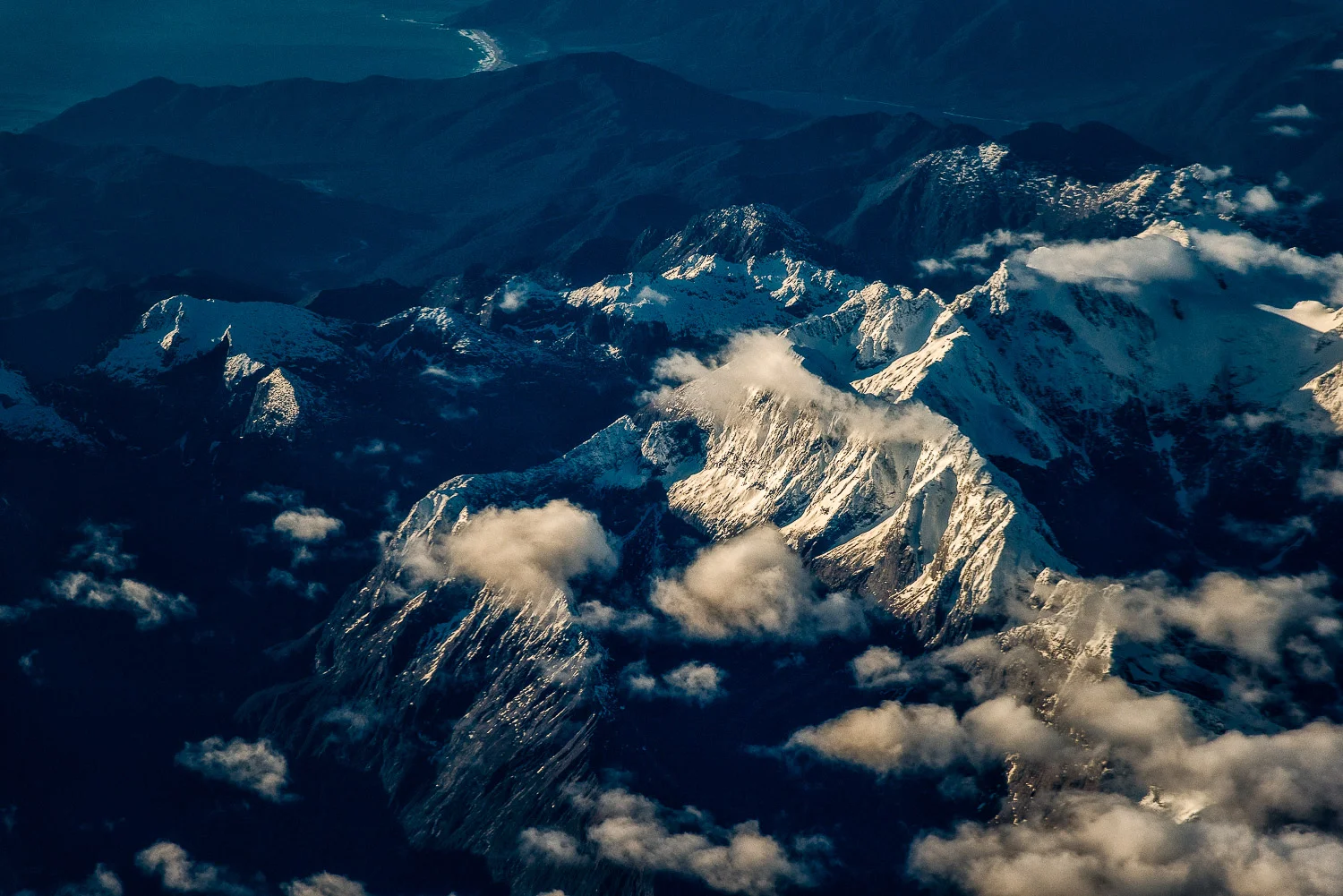
Aerial photography view of a snow-covered, mountainous landscape in Greenland.
Greenland Aerial Photography: What I Learned
I made the photos in this post flying, east to west, over Greenland on a flight from Iceland to the tourist town of Ilulissat in West Greenland.
This one conjured up thoughts of Mordor, in the middle of winter.
As the flight progressed three thoughts, in particular, lingered in my mind while flying over Greenland.
The immense size of the landscape below
The sheer beauty of that wild, barren and remote landscape
The brutal conditions you’d experience, if trying to cross that landscape in anything other than a plane
Greenland is, after all, mostly ice and rock, with very little foliage or, for that matter, people.
We’d begun our slow descent, towards the tourist town of Ilulissat, by the time I made this particular aerial photo.
As is so often the case, when flying in a commercial jet, a lot of compromises are involved for anyone trying to undertake aerial photography.
More often than not, you’ll be stuck in your seat with little or no opportunity to move around.
But it’s the windows that you photograph through that provide the biggest challenge. They’re a dense, curved acrylic (i.e., plexiglass) which, more often than not, could do with a good spit and polish.
Given the restrictions associated with photographing from a commercial jet, there are still some things you can do to improve image quality.
And these tips can also be applied when you’re a passenger photographing from a moving bus, boat or train.
Ensure you’re photographing with a fast shutter speed (i.e., 1/500 second or higher).
Because the earth, and even the clouds, are so far away you can achieve a large depth of field at a relatively wide Aperture (e.g., f/4).
However, if you want to include the aircraft’s wing in your photo, you may need to stop your lens down to an aperture around f/8 or f/11.
To reduce reflection, move in really close to the window. Just be sure not to let your camera’s lens, or any part of your body, touch the window as the vibration will likely result in camera shake.


This is the best photography course in Melbourne. Learn photography, master your camera and realize your creative potential by making beautiful, life affirming images.
I’m Glenn Guy, an experienced teacher and owner of the Travel Photography Guru website and blog.
Here’s the private photography course that’s specially designed around your needs, your camera and the photos you most want to create.
Learn Photography From The Travel Photography Guru
If you live in or around Melbourne, Australia, and are just about to head off on an adventure, please consider a private and highly personalized one-to-one photography coaching session with me.
It’s the best way to ensure you make great photos of your travels. The course will be constructed as follows:
Highly tailored to your own camera gear.
Explanations provided in line with your level of photographic experience.
Entirely based upon where you are going and the kind of photos you want to make.
I run these sessions all the time and they’re a lot of fun. It’s a great way to pack a lot of practical information into a short, fun session.
As a result of completing this session, your camera handling skills will dramatically improve, as will your confidence and willingness to experiment.
And that, my friend, is the beginning of truly creative travel photography.
If you have any questions please feel free to Contact Me directly.
Aerial photography really is a blast. If you ever have the opportunity to take great pics from a hot air balloon, helicopter or an airplane I’d recommend that you give it a go.
It’s a great experience and well worth the effort.
As with any kind of photography, practice makes perfect.
Nonetheless, I hope this post has provided you with useful information for how to go about your own aerial photography adventure.