
6 Simple Composition Techniques for Great Landscape Photos
Huangshan landscape photo showcasing composition techniques of symmetry, line and shape.
Let me share with you composition techniques for great landscape photos, illustrated with images I made while traversing the spectacular Mount Huangshan in Anhui Province, Eastern China.
Your landscape photos will dramatically improve via a series of powerful, yet easy to action composition techniques. Composing your landscape photos around line, shape, color, viewpoint, symmetry, balance, repetition and rhythm will result in visually beautiful and emotionally compelling images.
While traversing the trails that guide the way across the range of peaks comprising Mount Huangshan, I realized that I wanted to do more than simply document my journey.
I decided it would be fun to set myself the task of making some photos that were, primarily, studies in composition.
While the photos I made would include trees, mountain scenes and pathways, I wanted to construct them around important elements of composition, including the following:
Line and shape
Color
Viewpoint (angle of view)
Symmetry
Balance
Repetition
Rhythm
As a case in point, the photo at the top of this post depicts a stand of trees on a snow-covered landscape on Huangshan.
But look, more closely at the composition.
The tree trunks, which could be considered as lines and rectangular shapes, are arranged in a repetitive formation that suggests balance and rhythm.
Can I ask you to focus your gaze on the trees in the back left of the photo. From there, allow your gaze to travel to the tree trunks at the front of the image. Finally, follow the line of trees to the back right corner of the photo.
Notice that, for the most part, it’s a pretty symmetrical image.
Searching for the right place to set up my tripod while trudging, thigh deep, in snow made it impossible to create a perfectly symmetrical image. But I think you’ll agree it’s close.
Now let’s continue to explore how to use these and other great composition techniques to make really great landscape photos.
By bringing this approach into your own photography, you’ll find the quality of the landscape photos you create will improve dramatically.
1. Composition: Practice Really Does Make Perfect
The notion that practice makes perfect is well known and, frankly, obvious. But, by no means should it be taken for granted.
Actually, I pay attention to composition every time I make a photo.
Over the years, through sheer repetition of effort, I’ve become so proficient in this practice that I’m able to work intuitively and make decisions regarding composition really, really quickly.
This fact proves the motto that practice makes perfect.
In addition to the items in the bullet list above, I achieve good composition in landscape photos by considering the following:
Placement of primary focal points within the frame, and in relation to each other.
Negative Space to reduce clutter, direct viewer attention to the primary subject in a photo, and to evoke feelings such as power, alienation and solitude.
By taking well composed pics with my mobile phone.
Use Your Mobile Photo to Practice Photo Composition
Actually, I very rarely use my mobile phone to make landscape photos? But I still consider it an important bit of kit that helps me practice my composition techniques during times of creative malaise.
I recognize the value of a mobile phone to photographers, regardless of whether they’re at an amateur or enthusiast level. After all, mobile devices allow us to have a camera with us pretty much all the time.
Nonetheless, the quality from my mobile phone camera simply doesn’t match what I can achieve with my full frame mirrorless camera, particularly when making large display prints for exhibition.
It’s important to recognize that screens on mobile phones are optimized to display photos made on it or other, similar devices. This provides the best possible rendering of the landscape photos you’ve made with your phone camera, on that kind and size screen.
But try looking at those images, at a larger size, on a computer monitor or printed A4 or larger and they simply don’t look as good.
But for sharing images online, quickly and efficiently, mobile phone generated images are hard to beat.
It’s horses for courses.
But it’s also important to understand that opting for the convenience associated with mobile devices, when taking landscape photos, results in a loss of quality compared to taking the same photo with a mirrorless or DSLR camera.
However, given their accessibility, often in our pocket or handbag, a mobile phone is a great device to practice and improve the composition in your photos.
There’s no doubt that not having to think about shutter speeds, apertures and iso makes it easier to concentrate on composition when you’re out and about making portrait, architecture and landscape photos.
And the fact that mobile phone photography saves you from having to carry a camera backpack and tripod is a godsend.
Basically, I see my mobile phone as a way to quickly and easily make snapshots in a way that allows me to engage my brain and, with it, my heart and soul in an act of creativity.
Doing so allows me to tap into and exercise my inner, creative self without having to lug all my camera gear around, everywhere I go.
I can have a lot of fun making photos with my phone. I just don’t have high expectations of those pics.
It’s a compromise that I’ve learned to accept, when I’m out and about on my daily walks rediscovering familiar landscapes, both natural and urban, through the transient, transformational and, on occasions, transidental nature of light.
From my own experience, there’s a real benefit in making composition based landscape photos with my iPhone during times of creative stagnation.
Let’s face it, there are times when it’s hard enough getting off the couch and getting out the door. At times like this, the thought of having to carry a heavy camera backpack and tripod will default most folks.
So why I don't have high expectations for the photos I create on my mobile phone, by no means do I consider this to be a frivolous activity.
I’m much more likely to get up and go outside, into the fresh air and natural light, with no expectations other than enjoying myself and getting some much needed exercise.
Any landscape photos that result from this modest effort are a bonus, even if they’re only taken on my mobile phone.
Huangshan landscape photo using tree trunks and fence to explore composition techniques.
2. Use A Tripod To Improve Composition
When it comes to creating more contemplative landscape photos, the act of slowing down the process of composing the image can make a huge difference to the communicative power of the photos you make.
Under the right circumstances, consider employing a tripod so that you can slow down the process of image making and encourage a more contemplative and careful approach to composition in your landscape photos.
Mind you, it helps to have a good quality tripod. But it shouldn’t be so small that you have to bend over each time you use it. Doing so is uncomfortable and can place a real strain on your back.
Likewise, ensure you spend the money and get a high quality, yet quick and easy to use head for your tripod.
I prefer ball heads and I’ve got two models from Really Right Stuff that I’ve had since around 2010.
There’s an important, yet inconvenient, factor that needs to be understood when purchasing quality cameras, lenses and accessories.
Your initial financial outlay will be substantially higher. However, if you look after it, you’ll be able to use your gear for many, many years to come.
True value resides, not so much in the brand in which you invest your hard-earned money, but in how much you use it.
We all want smaller and lighter tripods, but be careful not to sacrifice stability and ease of use with convenience and lower prices.
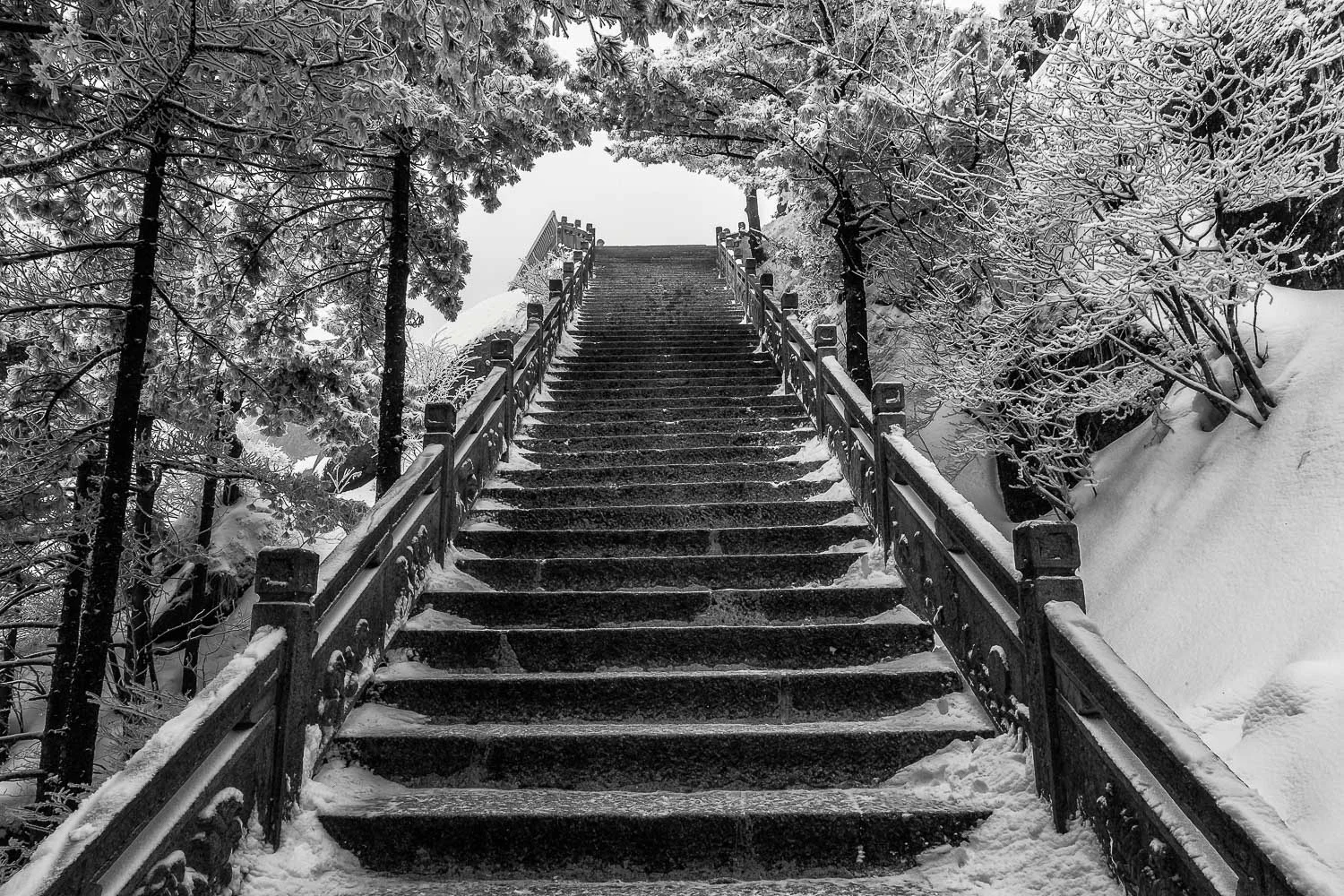
Dramatic landscape photo showing blue light and encroaching mist on Mount Huangshan.
3. Composition Can Affect The Mood Of Your Photos
Granted, you’ll almost always want to make sharp and correctly exposed photos. But, ultimately, you’ll want your photos to tell a story from your own life’s experience.
As a case in point, this photo shows the long and difficult road ahead, along a steep and narrow mountain path, as I continued on my trek, through the mist, on a cold winter’s day on Mount Huangshan.
I can tell you that the cold, flat and diminishing levels of light I witnessed while crossing that mountain pass only added to the sense of foreboding I felt as the mist began to roll in around me.
Fortunately, while I could still see the path ahead, I knew a hot shower and a good meal was not all that far away.
At least that’s what I told myself.
But far more important than mere creature comfort was the fact that I was in a position to make pretty dramatic and emotive landscape photos.
After all, I‘d travelled a long way and worked through some difficult experiences getting to this place. That only increased the need to soak it up and document my experience, in the best way I could.
I was cold and exhausted, but I knew I’d stay warmer and, possibly, avoid even more severe weather conditions if I kept moving onwards.
But there was a greater need that had to be served.
That voice in my head, some would call intuition, others my guardian angel that reminded me of why I was here, in this place at this very moment in time.
That was all that was needed to focus my will and encourage me to drag out my camera gear and make some more photos.
There really was no choice. I simply had to stop and take the time to make landscape photos that depicted the difficulty of the trail and speak to the anxiety that enveloped me at the time.
And the reward came almost immediately. Knowing I’d succeeded in making a good image provided me with the extra energy I needed to continue my journey.
Needless to say, there was no other choice.
So I climbed up, into the mist, and along that long, steep path in the hope that, once I’d reached the top of the pass, I’d be rewarded with another epic view and, perhaps, an easier road ahead.
Of course, we never really know what awaits us, beyond the range of our senses and any immediate point of reference.
But, for me, that’s the promise adventure offers us. Around the corner, or over the next mountain pass.
We all crave certainty and safety. But there remains a part of us that’s fascinated by the unknown.
Gandalf understood this when, trying to convince Bilbo to join Thorin Oakenshield’s company of dwarves on their adventure to the Lonely Mountain, he reminded Bilbo about his curious and adventurous mother, Belladonna Took.
And it was the awakening of that essential Tookish spirit within Bilbo that provided the courage he needed to embark on the grand adventure, alongside Gandalf and the dwarves.
Furthermore, this new found strength and conviction enabled Bilbo to dig deep and uncover the resourcefulness, guile and compassion needed to meet the challenges he faced and, as a result, become a far greater and more spiritually evolved Hobbit.
I discovered J.R.R. Tolkien’s classic fantasy adventure The Hobbit, There and Back Again at the age of 13.
Together with The Lord Of The Rings and The Silmarillion, it became a great solace for me during an absolutely horrendous time in high school, when education very much played second fiddle to torment and abuse, both physical and psychological.
Please remember that your most memorable landscape photos are those that connect, on an emotional level, with your audience.
And the best way to elicit an emotional response is to create images with mood.
Let’s look at a few simple examples:
Does the scene or subject depicted feel constrained by the surrounding frame, or does it appear alone and isolated within its surroundings?
Can you employ a more dramatic angle of view (e.g., worms eye or birds eye) to produce a more emotive result?
Consider how the quality, direction and color of the light affects the mood of the image you’re creating.
You might also ask yourself if the color palette of the photo fits one of the following criteria:
Pastel or highly saturated
Features harmonious, analogous or contrasting colors
Is predominantly monochromatic in color
For a better understanding of the nature of color, as an expressive tool in photography, please take a look at the following post:
Take another look at my photo showing part of the long, difficult path through the mist on Mount Huangshan.
Can you see the predominantly blue monochromatic color that’s being cast over the landscape?
It’s a result of the weather, which altered the color of the light illuminating this particular section of the trail.
In fact, due to deteriorating weather at the time, the bluish color cast was much stronger than you see here.
However, because I didn’t want the resulting image to appear to brooding or melancholic, I decided to shift the white balance of this particular landscape photo somewhat closer to neutral.
In the search for a more believable result, I wanted the viewer to feel rather than see the bluish color of the light washing over the landscape.
4. Photography And The Changing Color Of Light
The human brain, like your camera, is programed to neutralize such color. Only someone with a strong interest in color is likely to be aware of this fascinating phenomena.
The good news is that a better appreciation for the changing color of light, and how to use it creatively when taking your own landscape photos, is within reach.
It’s this kind of knowledge that opens up our perception of the world around us.
It’s also one of the jewels of knowledge that I most enjoy passing onto other folks, through articles like this and also in the private, one-to-one photography courses I run in and around Melbourne, Australia.
Would you like to know more about the color of light and the various white balance options within your camera’s menu?
I wrote a post titled Best White Balance Settings: How to Improve Your Photos Now which provides a comprehensive, yet highly accessible guide to mastering white balance.
I know you’ll dig it.
About To Travel?
5. Improve Composition By Using Your Camera’s Viewfinder
One thing that will dramatically improve your photography is to use your camera’s viewfinder, rather than its rear LCD screen, to compose your photos.
But to do so, you need to ensure that you can see all four edges of the frame while looking into the viewfinder. Unfortunately, eye glasses can make this more difficult to achieve.
You’ll probably find it helpful to turn your head slightly to the left or right when looking into the viewfinder.
Doing so can stop your nose from getting in the way as you try to comfortably position your preferred eye in the viewfinder.
Likewise, it’s frustrating trying to look at your photos when the rear LCD screen of your camera is dirty.
You’ll be amazed that, by keeping your nose from touching that screen, just how much easier it will be to view those landscape photos you’ve made.
What you want to see is the subject or scene you’re about to photograph, floating in space, and surrounded by blackness. It’s a bit like viewing the earth from space.
Notice how the image inside your camera’s viewfinder now appears to exist, somehow, outside of the surrounding world.
You’re no longer looking through your camera at the world around you, but creating an image outside and beyond your normal everyday experience.
This is important because your camera is no longer a physical barrier between you and the subject or scene you’re photographing.
“The image you’re creating exists, in a world of perpetual light, outside of and separated from the world around you.”
The simple process of being able to properly look inside your camera’s viewfinder will really concentrate your attention on the composition techniques required to produce great landscape photos.
No longer will you be accidentally cutting edges off interesting visual elements, like tree branches or rocks, in your landscape photos.
What’s more, by looking more carefully into your camera’s viewfinder, your attention will be drawn to those critically important numbers displayed along the bottom of the viewfinder.
I’m taking here about the shutter speed, aperture and iso at which you’re making your photos.
If you’ve set your camera to automatic iso, to fully automatic exposure modes (e.g., Ai or P), or to those semi automatic exposure modes like Shutter Priority (S or TV) or Aperture Priority you’ll lose control of the shutter speed, aperture and/or the iso.
When it comes to controlling sharpness in your photos, whether that be subject sharpness or depth of field, you really need to be aware and in control of the aperture, shutter speed and iso at which your photos are made.
If you make photos without paying attention to those numbers you’re simply not in control of the process, and, as a consequence, the final result.


This is the best photography course in Melbourne. Learn photography, master your camera and realize your creative potential by making beautiful, life affirming images.
I’m Glenn Guy, an experienced teacher and owner of the Travel Photography Guru website and blog.
Here’s the private photography course that’s specially designed around your needs, your camera and the photos you most want to create.
6. Adjusting Your Camera’s Diopter For Your Own Eyesight
Is all the information on the bottom of your viewfinder easy for you to read? If it’s not, you’ll avoid looking at those numbers and, as a consequence, lose access to vital information about how your photos are being made.
If you can see the numbers, but they appear unsharp, adjust your camera's built in diopter adjustment so that it's aligned with your own eyesight (e.g. -2, +1, etc).
You’ll find the diopter adjustment along one edge of your camera’s viewfinder. Either slide or turn it until the numbers are razor sharp.
If it’s a dial and it won’t move, try lifting it (but not to forcefully) outwards to unlock the device before turning it to achieve the desired result.
Wow! I was blind, but now I can see.
With luck you’ll be able to adjust the diopter in your viewfinder to such an extent that you won’t need to wear your glasses while making photos.
From my own experience, this is an absolute game changer, making the process of taking photos so much easier and more enjoyable than it otherwise would be.
However, as there’s no diopter adjustment for your camera’s rear LCD screen, you’ll need to put your glasses back on to check your photos on a DSLR camera.
If you have a mirrorless camera, and why wouldn’t you, this issue is minimized because immediately after you’ve made each photo it will be displayed inside your camera’s viewfinder.
This means you’ll be able to view your images without taking your eye away from the viewfinder, and without having to deal with nasty reflections when checking photos on the rear LCD screen of your camera.
Conclusion: Great Landscape Photos Await you
Have no doubt, by implementing the simple to action composition techniques I’ve outlined throughout this post, your ability to create superior landscape photos will dramatically improve over time.
This means better landscape photos, more often.
I wish you well in your future landscape photography endeavors and ask that, if you value the information I’ve created for you in this post, that you take a moment to share it widely and wildly.


Let me share with you powerful, yet easy to action composition techniques for great landscape photos, illustrated with images I made while traversing the spectacular Mount Huangshan in Anhui Province, Eastern China.